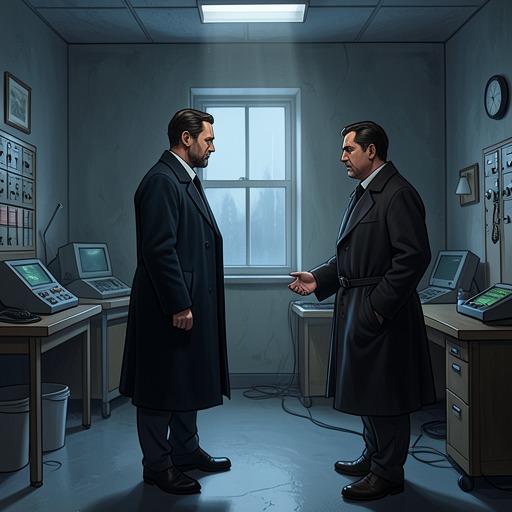
Soviet Intelligence Center
The Spy Who Came in from the ColdMoscow Centre is the Soviet intelligence organization invoked within the novel’s interrogation and intelligence traffic, linking Leamas’s disclosures to a wider contest over what information is genuine, useful, or deliberately misleading. Its presence is most visible through questions about whether it is involved and through the onward transmission of interrogation material; the evidence does not describe its internal structure or establish its precise role in the operation.
Presence in the Interrogation
During questioning, Leamas recognizes Peters as an expert and asks whether Moscow Centre is involved. Peters does not answer; he studies Leamas before turning to the subject of Leamas’s wartime service. The exchange makes the possibility of Soviet oversight part of the interrogation’s atmosphere, but leaves it unresolved. Moscow Centre is named as a potential participant, not shown directing the questioning.
Peters later challenges Leamas’s account of the intelligence Karl Riemeck supplied, remarking that Riemeck must have had help. Leamas connects this insistence with an earlier question from Control about Riemeck’s access and wonders whether an undisclosed high-level collaborator lies behind the material. The connection makes the inquiry into Riemeck’s sources more than a dispute over what one agent could obtain: it raises the possibility that separate services are testing the same gap in the account. The evidence does not identify Moscow Centre as that collaborator or confirm that it knows the answer.
Intelligence and Transmission
The material attributed to Riemeck spans unusually consequential subjects. Three films contain minutes from a meeting of the Praesidium, a proposed revision of East Germany’s relationship to COMECON, and an organizational breakdown of the East German Intelligence Service. Peters’s question about whether all this came from Riemeck underscores the scale of the disclosures, while Leamas insists that Riemeck had access to the information. The exchange leaves the question of assistance open and makes the provenance of intelligence as important as its contents.
Moscow Centre’s most concrete administrative presence appears in the account of Peters recording Leamas’s answers. Peters’s notes are to provide background for that evening’s telegram to Moscow; meanwhile, at the Soviet Embassy in The Hague, women stay up through the night sending a verbatim transcript on hourly schedules. The process turns a drawn-out interrogation into material for remote analysis, with handwritten notes and transmitted text carrying different stages of the report. The scene gives the organization a role in the communications chain without depicting its headquarters or identifying who receives the telegram.
Operation Rolling Stone and Uncertain Evidence
The interrogation repeatedly tests whether Leamas’s disclosures justify the price attached to them. Fiedler distinguishes the already-known information about Riemeck and the Berlin organization from the still-unresolved question of Operation Rolling Stone. Leamas explains that indications of a spy may justify suspicion without identifying the country the spy serves or making arrest possible. In this account, intelligence is not self-interpreting: scattered clues must be weighed, and the possibility of an outside service complicates the reading of each clue.
Financial evidence sharpens that problem. In the tribunal’s review, Fiedler describes Leamas’s Copenhagen deposit and the withdrawal of the full ten thousand dollars by a co-signatory one week later, on a date when Mundt was in the city. He also links Leamas’s Helsinki visit to Mundt’s clandestine journey to Finland shortly afterward. Fiedler presents the timing as evidence against Mundt, while the novel’s surrounding deception makes the evidentiary pattern vulnerable to reinterpretation. Moscow Centre is not identified as the author or verifier of these clues; its significance lies in the wider intelligence contest in which information moves between interrogators and distant recipients while its meaning remains contested.
Limits of the Organization’s Portrayal
The novel supplies no organizational chart, named officials, or account of Moscow Centre’s methods beyond the interrogation reference and the transmission of reports to Moscow. Its presence is therefore functional rather than fully dramatized: it marks a larger intelligence audience and a channel through which disclosures can be processed beyond the immediate scene. This limited portrayal sustains uncertainty about how much the Soviet service knows, what it concludes, and how its interests intersect with the competing interpretations of Leamas’s evidence.